Claude & ChatGPT connector (MCP)
Platform (dbtCharts.com)
This page describes dbt Charts Platform, the
hosted product at dbtCharts.com. These features are not part of the
open source dct engine.
This is the main way to use dbt Charts from an AI assistant. dbt Charts Platform
is a remote MCP server: paste one URL, https://dbtcharts.com/mcp, into
Claude or ChatGPT and chat with your boards and your warehouse from there:
find a board, read what it shows, run the queries behind it, and have the AI
draw new charts inline, all signed in as you, with your own permissions.
It works in the ordinary Claude and ChatGPT apps (web, desktop, and mobile).
You don't need a coding agent such as Claude Code or Codex, a git checkout,
or the dct CLI: there is nothing to install, and nothing runs on your
machine.
By default the connector serves every organization you belong to, including ones you join later, through that one URL. You add it once, not once per organization or project: search spans every project you can reach in those organizations, and each call is still checked against your access to the specific project and data source it touches. You can limit it to specific organizations on the consent screen, and change that later without reconnecting.
This page walks the whole flow: connecting, what the connector can do, what the consent screen grants, and how to see, change, and remove access later.
Looking for dct mcp serve?
The local MCP server that ships with the dct CLI is a different thing,
for a few narrower cases such as an editor agent working on files in a
local checkout. CLI and MCP for AI assistants
compares the options.
Connect from Claude
- In Claude, open Settings → Connectors and choose Add custom connector.
-
Name it (for example,
dbt Charts) and paste your server URL: your Platform origin plus/mcp, for examplehttps://dbtcharts.com/mcp.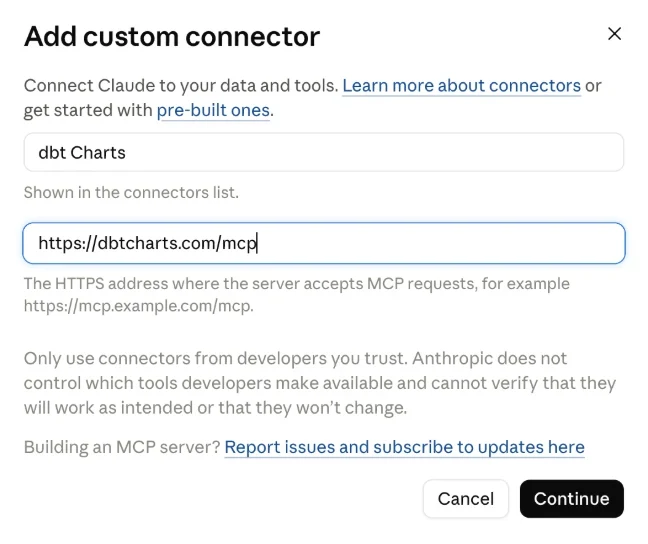
-
Choose Continue. Claude discovers the sign-in flow on its own, with no client ID or secret to fill in. When you start from Claude Desktop, your browser first opens claude.ai asking Finish connecting a connector?; choose Continue connecting. You'll then be sent to dbt Charts Platform to sign in (if you aren't already) and to the consent screen described below. Approving returns you to Claude.
- Back in Claude, open the connector's Tool permissions and switch the read-only group from Needs approval to Always allow. Claude starts every tool of a new custom connector on Needs approval, which asks you to confirm each call. Leave the write group on Needs approval: it saves, moves, and deletes boards, so you confirm each one.
On a Claude Team or Enterprise plan, only an organization owner can add a
custom connector. If Add custom connector is disabled for you, ask an
owner to add https://dbtcharts.com/mcp for the organization. It then
appears in your connector list with a Connect button, and you sign in to
dbt Charts Platform as yourself from there.
Claude connects from Anthropic's cloud, not from your device, so the server URL must be reachable from the public internet. Details and plan availability are in Anthropic's own guide: Get started with custom connectors using remote MCP.
Install for your whole Claude organization
The dbt-charts Claude plugin is for claude.ai and Cowork, where Claude has
no shell: it bundles this connector with the board authoring skills (the
chart and styling references, plus chart-building and board-replication
workflows), so Claude follows them without being asked. It lives in the
public dbt-labs/dbt-charts repository, which is a plugin marketplace.
Claude Code does not need it. In a repository with the dct command line
installed, run dct init skills instead: it writes one dct skill that sends
Claude Code to dct skills chart, and the agent works through the CLI with
no connector or sign-in. See dct init skills.
On claude.ai and Cowork, an organization owner distributes the plugin from
Organization settings → Plugins & skills. Organization sync reads only
private or internal marketplace repositories, so list the public plugin
from a private marketplace repository of your own. Its
.claude-plugin/marketplace.json:
{
  "name": "your-org-plugins",
  "owner": {
    "name": "Your IT team"
  },
  "plugins": [
    {
      "name": "dbt-charts",
      "source": {
        "source": "git-subdir",
        "url": "dbt-labs/dbt-charts",
        "path": "plugins/dbt-charts"
      }
    }
  ]
}
- Choose Add → Sync from GitHub and pick that repository.
- On the Inventory tab, set
dbt-chartsto Installed by default (members can turn it off) or Required. - In Organization settings → Connectors, add
https://dbtcharts.com/mcp. A plugin's availability doesn't add its connector; each member then connects it and signs in to dbt Charts Platform as themselves.
Anthropic's guide covers the rest: Manage plugins for your organization.
Connect from ChatGPT
- In the ChatGPT desktop app, open Settings → Plugins and choose Add MCP server.
- Set Type to Streamable HTTP.
- Name it (for example,
dbt Charts) and paste your server URL: your Platform origin plus/mcp, for examplehttps://dbtcharts.com/mcp. - Sign in to dbt Charts Platform (if you aren't already) and approve on the consent screen described below. ChatGPT registers itself as a client automatically, so there is no client ID or secret to fill in.
If you don't see Add MCP server, your plan or workspace permissions may not allow custom MCP servers. OpenAI's setup guide has the current steps.
ChatGPT registers through anonymous dynamic client registration (DCR) rather
than Claude's client ID metadata documents. With that mechanism the app names
itself, so the consent screen marks the name Unverified name beside the
site your browser returns to after you approve. Continue only if that is the
site you came from (for ChatGPT, chatgpt.com).
What the connector can do
The connector exposes fifteen tools. Hosts decide when to call them; this is what each one does and what it's allowed to touch:
| Tool | What it does | Checked against |
|---|---|---|
search_files |
Finds boards by name, title, or notes across every project you can reach, or lists all of them when no text is given. With kind, searches a project's meta.yml files, dbt models, or config files instead and returns the matching lines |
Your board access for boards; project membership for other files |
read_file |
Reads one file from a project, such as a meta.yml or a model's schema.yml, or one of your drafts |
Your board access for a board file; any other file is read as a project member. A dbt profiles.yml outside the board folders is never shown |
write_file |
Saves a file in a project, such as a board at charts/finance/revenue.yml. Each write is one commit on the project's dbt Charts branch. Overwriting an existing file needs the hash read_file returned, so a board changed since it was read is not overwritten |
Needs the dashboards:write scope, and edit access to the board's folder |
move_file |
Moves or renames a board, rewriting links to it. Moving a draft into a folder is how it gets saved | Same as write_file, on both the source and the destination |
delete_file |
Deletes a board | Same as write_file |
describe_board |
Lists a board's charts, queries, and variables | Your board access |
render_board |
Renders a stored board, or a whole board of YAML the host authors on the fly, and saves that YAML as a private draft | Your board access, or your query permission on any connection the YAML touches |
execute_sql |
Runs a board's named query, or direct SQL, against a connected source | Your query permission on that source |
list_skills |
Lists dbt Charts' authoring guides (board-building workflows, chart-layout patterns) | Nothing when no project is named. Naming a project also lists that project's own skills, and needs your access to that project |
get_skill |
Reads one skill's full guide by name | Same as list_skills |
list_diagnostic_codes |
Lists the error and warning codes a render can report, optionally by level | Nothing; the registry is the same for everyone |
get_diagnostic_code |
Explains one diagnostic code and how to fix it | Nothing |
list_comments |
Lists the comment threads on a board: the quoted text, the chart or block it sits on, replies, and whether it is resolved. Open threads unless asked for resolved or all |
Needs the comments:read scope, and your access to the board |
post_comment |
Starts a thread on a board by naming a chart or block (owner) and the words to quote, or answers a thread by its id. The quote must be in the owner's title, subtitle, or prose; a quote it cannot find is refused |
Needs the comments:write scope, and your access to the board. The comment is yours |
resolve_comment |
Resolves a thread | Needs the comments:write scope. Only the thread's author or a board editor may resolve |
execute_sql returns its rows to the AI as CSV bounded at about 25,000 tokens.
You see nothing from it directly: the AI answers with a chart it renders through
render_board. The tool has no row-limit argument: the AI writes LIMIT and OFFSET in the SQL, and a result that was
cut says so.
Each board result from search_files or describe_board names its project's sources:
the data sources you may query there, each with its SQL dialect (or its type,
when the dialect is only known at run time). A source you have no query
permission on is left out. When the project has a default source, it is marked
default: true and the AI may omit source. A failed execute_sql names
the source it ran on.
Queries are statement-guarded, row-capped, and time-limited. The
connector asks for no administration scope: those are the scopes the Platform API
requires to change members, project settings, and warehouse connections (the
ones dct cloud asks for), and no tool here uses them. Clicking a chart or a
title in a rendered board's widget opens the board, or its draft, in the dbt
Charts Platform editor. A
board built entirely from inline rows (a type: values query, the shape
another AI tool's results arrive in) touches no data connection at all, so it
renders even for a user whose organization has no warehouse connection
configured yet.
Boards over uploaded files cannot be authored from Claude or ChatGPT yet: an
inline render_board YAML that queries a project's file source (a
csv/json/parquet source declared in your project's dbt_charts.yml, with no
warehouse connection behind it) is refused. That data is still visible
through search_files/describe_board/render_board on any
stored board that already queries it; only an on-the-fly board over it,
authored live in the chat, is not yet supported. Build that board in the
Platform editor or in chat inside dbt Charts Platform itself instead.
The tool list is the same for every user. If you call a tool your permissions don't cover, you get an error naming what was denied rather than a hidden tool.
Saving boards
A board the AI builds with render_board from YAML is saved as a draft: a
private file only you can open, shown in the result as a link to the dbt Charts
editor. It is not part of your project until you keep it. The AI revises the
same draft when you ask for changes, rather than creating a new one each time.
To keep a board, ask the AI to save it to a folder, for example "save this to finance". The AI moves the draft there (or writes the board directly) and gives you the saved board's link. The save is a commit on the project's dbt Charts branch, or on your own change branch when the project uses branch mode. The AI saves a board only when you ask. You can also open the draft's link and save it from the editor.
Saving needs the dashboards:write scope and edit access to the folder. A
connector you added before this scope existed does not have it. A write call
then fails with an error naming the scope, and the board is still rendered but
not kept as a draft. Disconnect the connector and connect it again to grant the
scope. A user with the Viewer role renders boards but cannot keep drafts.
The comment tools use the same service as the comments on a board page, so a comment posted here notifies and shows up exactly as one typed in the browser. A connector you added before the comment scopes existed has to be disconnected and connected again to grant them; a call then fails with an error naming the scope. The same threads are available over the Comments API.
Seeing what the connector reaches
A page of search results is only a sample of your boards, so every
search_files result also says what the connection can reach:
scopelists every organization the connector may reach and, under each, its projects. A project'srefis<organization>/<project>, the same path its URL uses, so two projects with the same name in different organizations are told apart.totalis the number of boards that matched across all pages, after your board access is applied. The last page has nonext.projectsis an optional argument that limits a search to the projects you name, asrefvalues taken fromscope. Leave it out to search everything the connector reaches. A ref that names no project you can reach is an error, not an empty page, and the error does not say whether the project exists.
The consent screen
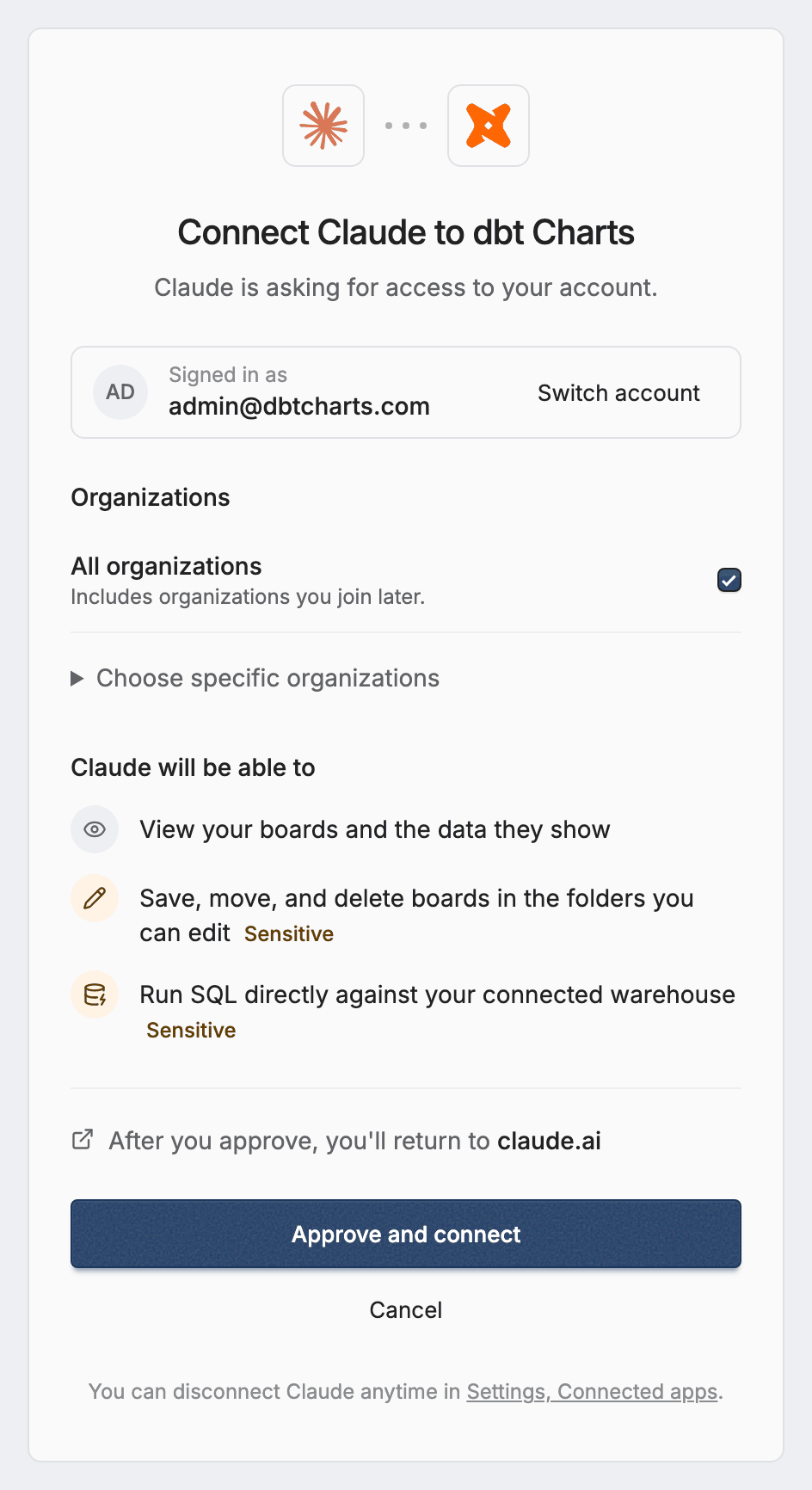
Connecting sends you to dbt Charts Platform to approve the client. The consent screen shows which account you're signed in as and asks which organizations the connector may reach. All organizations is checked by default, and it includes organizations you join later, so an organization you create or join afterward is reachable with no reconnecting. To limit the connector, open Choose specific organizations, uncheck the all box, and check only the organizations you want; it then reaches just those, and a new organization stays out of reach until you reconnect and add it. When you reconnect, the screen starts from the current choice. The shared demo organization is never listed, and the connector cannot reach it.
Below the organizations, the screen lists what the connector will be able to do:
- View your boards and the data they show.
- Run SQL directly against your connected warehouse, marked Sensitive.
- Save, move, and delete boards in the folders you can edit, marked Sensitive.
Running SQL reaches your data directly, even though nothing it returns is written anywhere. Approve a connector the way you'd approve any tool that can see your data. Approve and connect grants every scope listed; Cancel grants nothing. If a connector you connected earlier listed administration scopes, it keeps them until you disconnect it under See and revoke access below and connect again.
What the connector may access
The scopes you grant are a ceiling, never a widening. A connector acting for you can reach at most what you can already reach in dbt Charts Platform: each call re-checks your own access grants against the specific project and source it resolves to. Granting the warehouse-query scope to a user who doesn't hold query permission on a source grants nothing on that source, and the write scope grants nothing in a folder you cannot edit.
Queries the connector runs are attributed in your warehouse's job history with opaque per-user and per-request labels, so an administrator can answer "who ran that query" without any personal data appearing in warehouse metadata.
See, change, and remove access
In dbt Charts, open Account Settings → Connected Apps. It shows one card for each client with active access to your account, whether Claude, ChatGPT, or anything else you've authorized, with the organizations it reaches, the scopes it holds, and when its token was issued.
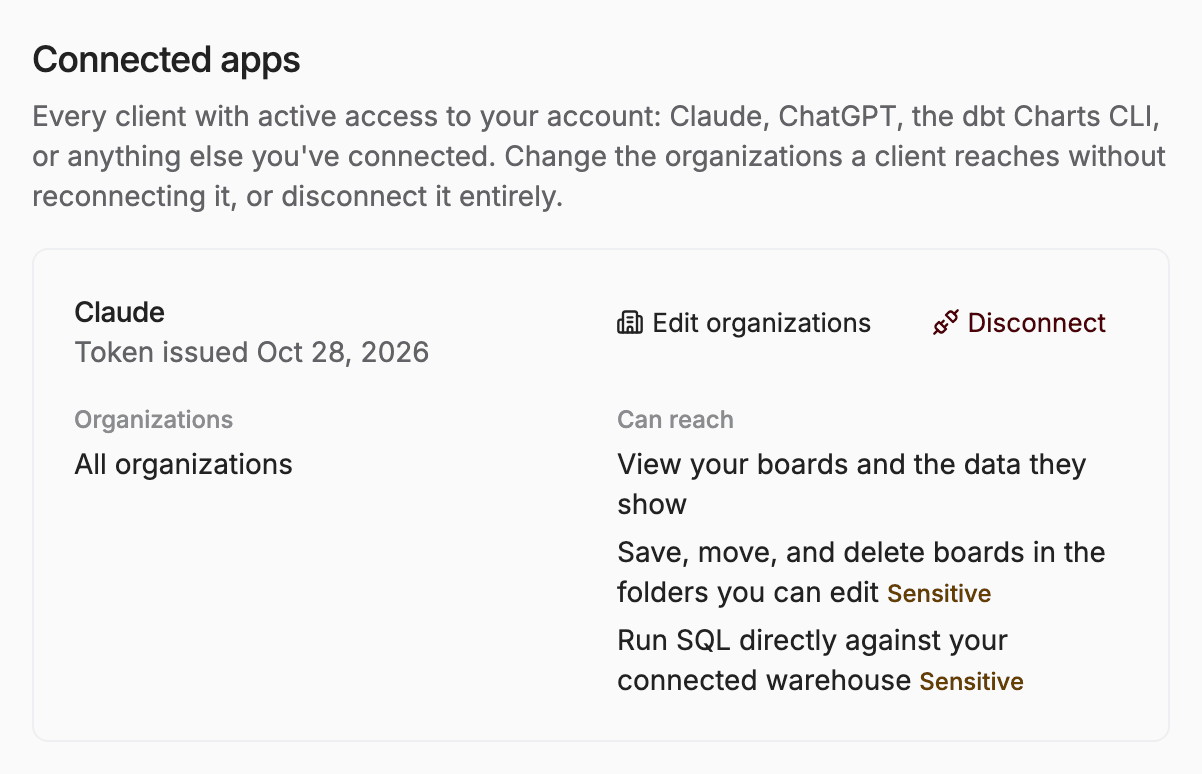
Edit organizations changes which organizations a client reaches: all of them, including ones you join later, or only the ones you check. The change takes effect on the client's next call, and you don't reconnect or reauthorize anything. The scopes stay as you granted them.
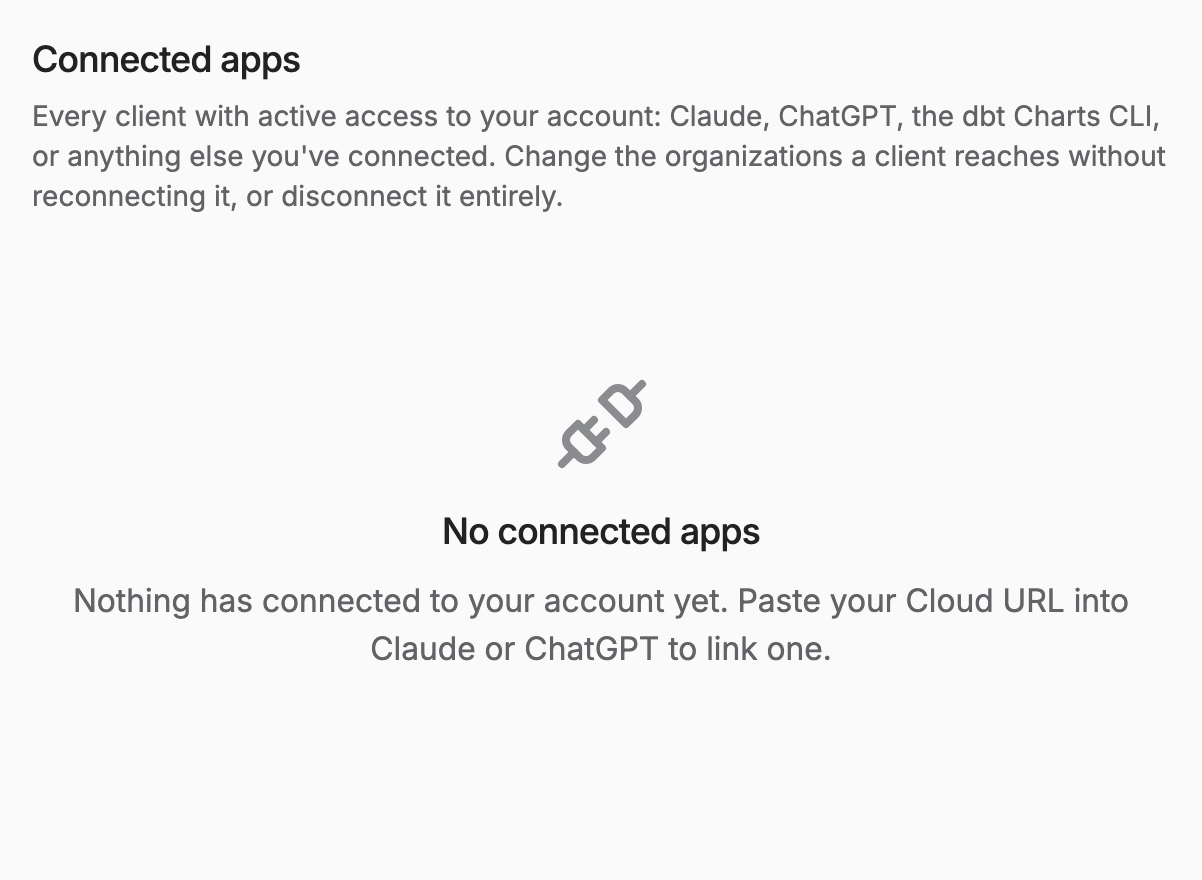
Disconnect removes a client from every organization at once: its tokens are invalidated at that moment, and its next call fails. Reconnecting is the same paste-and-consent flow from scratch.
Related
- Access control: the grants every connector call is checked against
- CLI and MCP for AI assistants: when to use the local CLI/MCP instead
- Data connections: connecting the warehouse sources queries run against