Claude & ChatGPT connector
dbt Charts Cloud
This page describes dbt Charts Cloud, the hosted
product — these features are not part of the open source dct
engine.
dbt Charts Cloud is a remote MCP server: paste one URL into Claude and chat with your boards and your warehouse from there — find a board, read what it shows, run the queries behind it — signed in as you, with your own permissions. ChatGPT support is coming (see below). This page walks the whole flow: connecting, what the consent screen grants, and how to see and revoke access later.
The connector serves your whole organization through that one URL. You add it once, not once per project: search spans every project you can reach, and each call is still checked against your access to the specific project and data source it touches.
If you're looking for the local MCP server for editing a project on your
own machine (Cursor, Claude Desktop against a checkout), that's
dct mcp serve — a different thing. This page is about
reaching your hosted projects from Claude.
What the connector can do
The connector exposes five tools. Hosts decide when to call them; this is what each one does and what it's allowed to touch:
| Tool | What it does | Checked against |
|---|---|---|
search_dashboards |
Finds boards by name, title, or notes across every project you can reach | Your board access |
describe_dashboard |
Lists a board's charts, queries, and variables | Your board access |
render_dashboard |
Returns a board's rendered results | Your board access |
run_query |
Runs a board's named query, or direct SQL, against a connected source | Your query permission on that source |
draft_chart |
Saves an AI-generated chart as a draft in a project | Query permission + the chart-drafts scope |
Every tool call is read-only against your warehouse (queries are
statement-guarded, row-capped, and time-limited), and draft_chart is the
one tool that writes anything — a chart draft inside dbt Charts Cloud, never
to your warehouse.
The tool list is the same for every user. If you call a tool your permissions don't cover, you get an error naming what was denied rather than a hidden tool.
Connect from Claude
- In Claude, open Settings → Connectors and choose Add custom connector.
- Paste your server URL: your Cloud origin plus
/mcp— for examplehttps://dbtcharts.com/mcp. - Claude discovers the sign-in flow on its own — there is no client ID or secret to fill in. You'll be sent to dbt Charts Cloud to sign in (if you aren't already) and to the consent screen described below.
Claude connects from Anthropic's cloud, not from your device, so the server URL must be reachable from the public internet. Details and plan availability are in Anthropic's own guide: Get started with custom connectors using remote MCP.
Connect from ChatGPT
Not yet supported. ChatGPT registers MCP connectors through anonymous dynamic client registration, which dbt Charts Cloud doesn't accept today — Claude connects through a different identity mechanism (client ID metadata documents) that Cloud does support. Pasting the server URL into ChatGPT's Developer mode will stall at the sign-in step; this page will be updated when ChatGPT can connect.
The consent screen
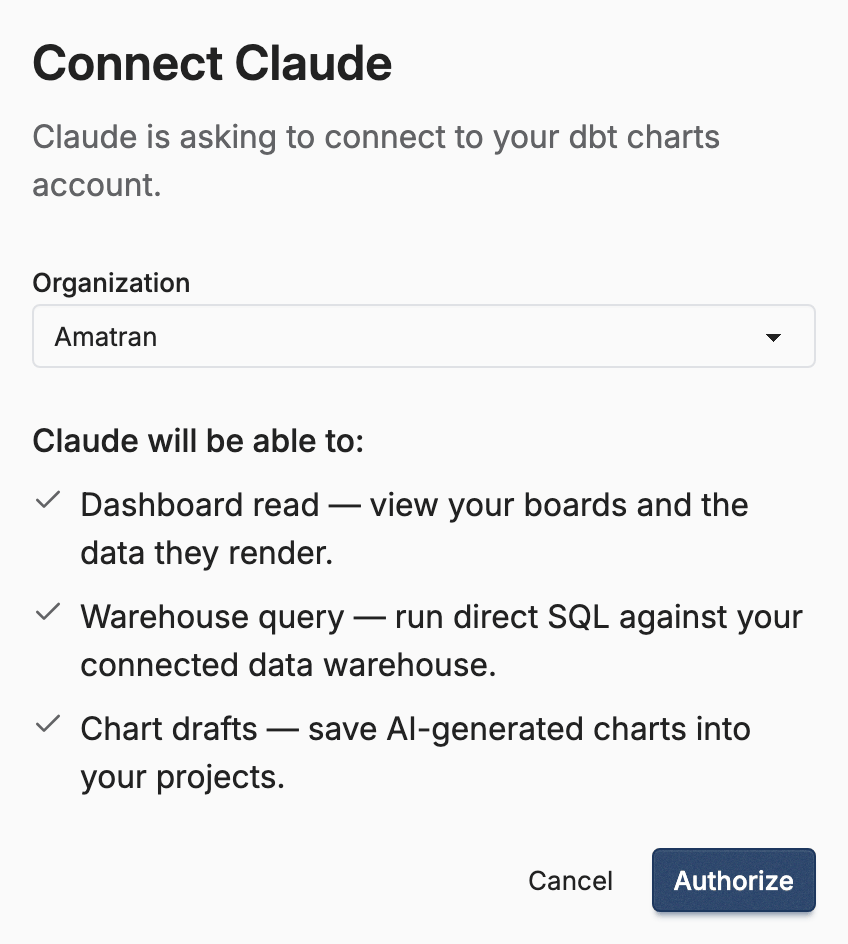
Connecting sends you to dbt Charts Cloud to authorize the client. The consent screen asks two things: which organization the connector may reach, and whether you grant each of three scopes — listed separately because they are not equivalent:
- Dashboard read — view your boards and the data they render.
- Warehouse query — run direct SQL against your connected data warehouse.
- Chart drafts — save AI-generated charts into your projects.
This grant is not read-only: warehouse query runs real SQL, and chart drafts saves content. Authorize a connector the way you'd authorize any tool that can see your data.
What the connector may access
The scopes you grant are a ceiling, never a widening. A connector acting for you can reach at most what you can already reach in dbt Charts Cloud — each call re-checks your own access grants against the specific project and source it resolves to. Granting the warehouse-query scope to a user who doesn't hold query permission on a source grants nothing on that source.
Queries the connector runs are attributed in your warehouse's job history with opaque per-user and per-request labels, so an administrator can answer "who ran that query" without any personal data appearing in warehouse metadata.
See and revoke access
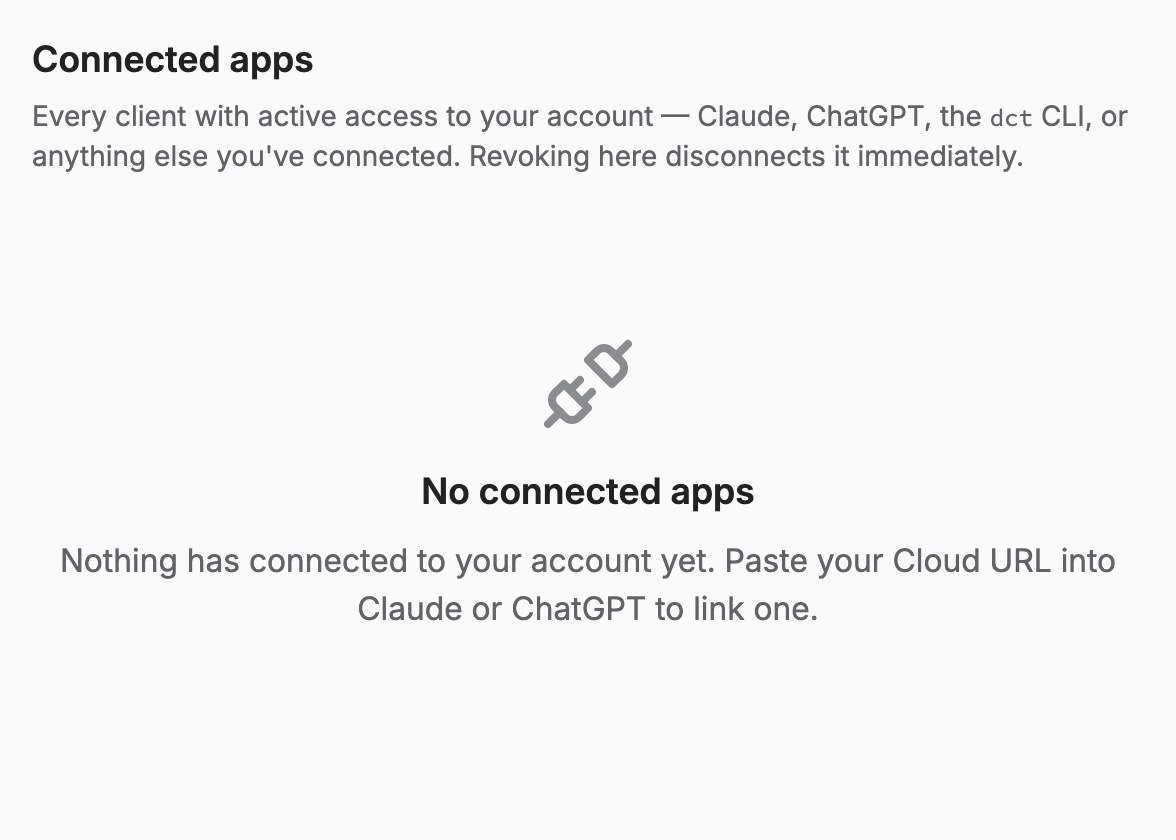
Settings → Connectors (/settings/connectors) lists every client with
active access to your account — Claude, ChatGPT, or anything else you've
authorized — with the organization it reaches, the scopes it holds, and when
its token was issued.
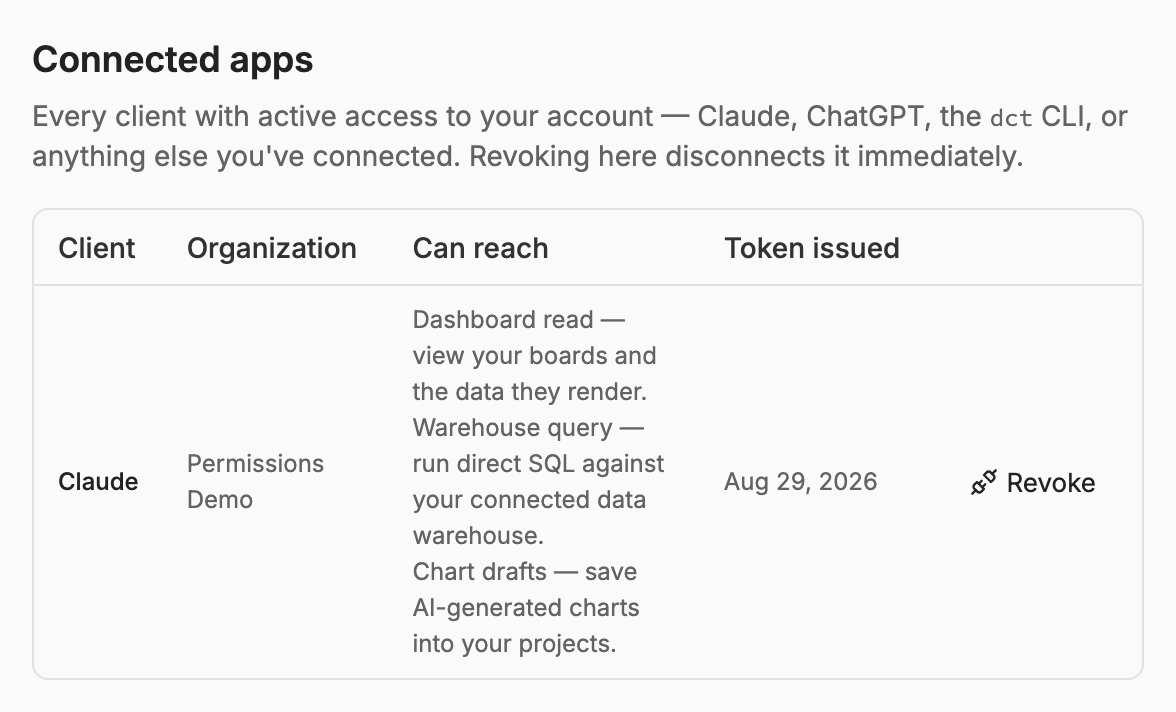
Revoke disconnects a client immediately: its tokens are invalidated at that moment, and its next call fails. Revoking a client disconnects it for your account across organizations — reconnecting is the same paste-and-consent flow from scratch.
Related
- Access control — the grants every connector call is checked against
- CLI and MCP for AI assistants — when to use the local CLI/MCP instead
- Data connections — connecting the warehouse sources queries run against